You’re Already Using AI. Here’s Why Your Results Still Look Average.
A practical guide to prompt engineering, AI workflows, tool integration, and responsible use — for people past the basics
Everyone has access to the same models. So why do some people get outputs that need a light edit, while others get outputs that need a rewrite? It’s not the tool — it’s the system around it: technique, systems thinking, and judgment. Here’s how to build all three.
Prompting Is Specifying, Not Asking
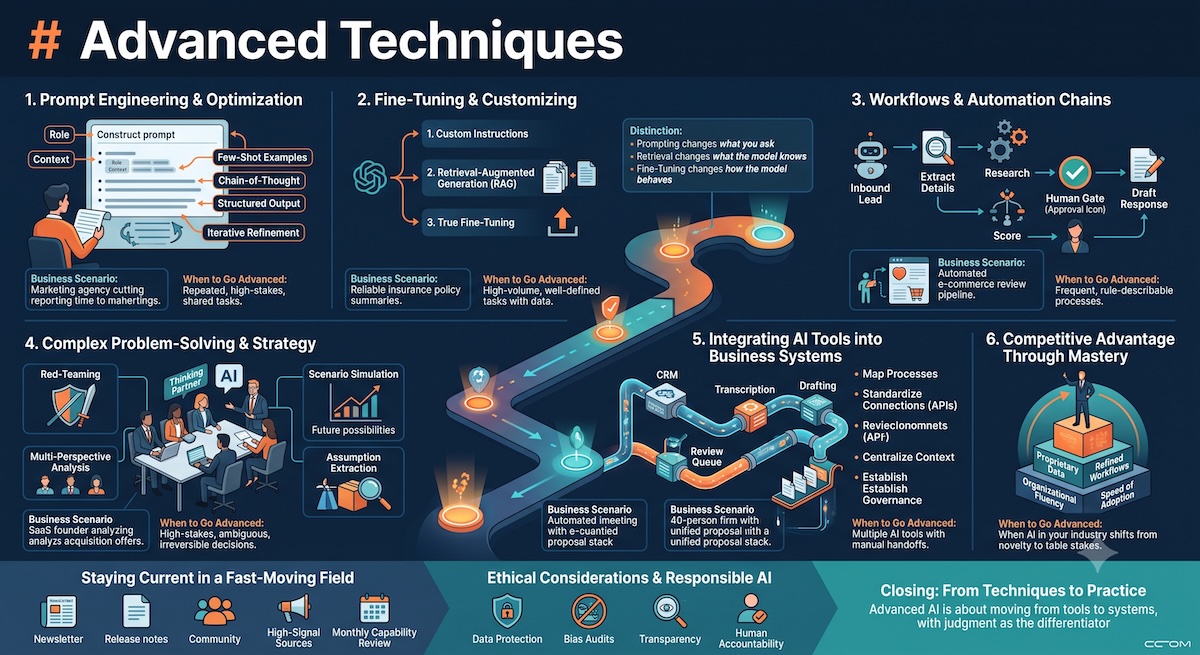
Basic prompting asks a question. Advanced prompting controls the model’s role, context, reasoning process, output format, and constraints — the way a good manager writes a clear brief instead of a vague request. A well-engineered prompt can outperform a casual one by an order of magnitude on complex tasks.
- Role and context loading. Instead of “write a sales email,” specify the situation: “You are a B2B sales strategist. Our prospect went quiet after a pricing call. Write a re-engagement email addressing the unspoken price objection without discounting.” Context is the highest-leverage input you control.
- Few-shot examples. Show two or three examples of the output you want and the model matches the pattern — this beats describing what you want.
- Chain-of-thought prompting. For analytical work, instruct step-by-step reasoning before the answer to measurably improve accuracy.
- Structured output. Specify the format explicitly, and output becomes a deliverable instead of a draft you reformat.
- Iterative refinement. Treat winning prompts as assets: save, version, and refine them like email templates.
One marketing agency cut a four-hour monthly reporting task to forty minutes with a single master prompt — role, context, example reports, structure, tone rules — and got more consistent quality across account managers in the process.
Engineer a prompt when the task is repeated, high-stakes, or shared across a team. A one-off question doesn’t need it; a weekly workflow does.
Fine-Tuning: The Option You Probably Don’t Need Yet
Fine-tuning trains a model on your own examples so its behavior shifts toward your tone, terminology, and formats. A useful rule: prompting changes what you ask, retrieval changes what the model knows, fine-tuning changes how it behaves.
Work through the lighter options first:
- Custom instructions and system prompts — persistent instructions applied to every conversation. Zero cost, immediate.
- Retrieval-augmented generation (RAG) — connect the model to your knowledge base so answers draw on your actual documents. Solves most “the AI doesn’t know our business” problems.
- True fine-tuning — supply hundreds to thousands of example pairs. Justified when you need consistent behavior at scale that prompting can’t produce.
An insurance brokerage got policy summaries 85% right with prompting alone; fine-tuning on 2,000 approved summaries pushed reliability high enough to move review from every output to spot-checks — the difference between AI as an assistant and AI as a production system.
Fine-tune only with a high-volume task, hundreds of quality examples, and proof prompting and RAG have hit a ceiling. Doing it too early is the most common advanced-user mistake — expensive, and prompting would’ve probably worked anyway.
Chain Your Prompts Into Workflows
A single AI call answers a question. A workflow chains multiple steps — AI and non-AI — into a system that runs with minimal supervision. Each step does one job, passes structured output to the next, and includes checkpoints where a human reviews before anything consequential happens.
- Decompose the task. “Handle inbound leads” becomes: extract details ? research the company ? score fit ? draft a response ? queue for approval.
- One job per step. A prompt that classifies and summarizes and drafts does all three worse than three chained prompts.
- Add human gates. Checkpoints before anything external-facing or irreversible: sending, publishing, purchasing, deleting.
- Use orchestration tools. Zapier, Make, and n8n connect AI steps to your email, CRM, and databases without code. Start with fixed chains; graduate to agents once you trust the components.
One e-commerce company built a nightly pipeline — reviews flow in, AI classifies sentiment, negative shipping reviews route to ops with a drafted response, a weekly digest goes to product — turning a neglected quarterly chore into a daily feed built in an afternoon with no engineers.
Pasting output from one AI conversation into another more than twice? That’s a chain waiting to be automated.
Use AI to Pressure-Test Decisions, Not Just Answer Questions
Basic use asks AI for answers. Advanced use recruits it as a thinking partner — generating options you hadn’t considered, stress-testing assumptions, arguing against you. The goal isn’t to outsource the decision; it’s to make your process more rigorous than you could manage alone.
- Red-teaming. “Argue the strongest case that this strategy fails. Identify the assumptions that, if wrong, break the plan.”
- Multi-perspective analysis. Run the same decision through separate passes — CFO, customer, competitor, regulator. Each surfaces objections a single analysis misses.
- Assumption extraction. “List every assumption this plan depends on, ranked by how catastrophic it would be if false and how little evidence we have for it.” One of the highest-value prompts in business use.
A SaaS founder weighing two acquisition offers used AI to compare deal terms, retention risk, and cultural signals, plus a red-team pass on each option — walking into negotiations with a sharper map of leverage points than either acquirer expected.
Reserve these for decisions that are high-stakes, ambiguous, and one-way. Routine decisions don’t need the overhead.
Stop Choosing Tools. Start Designing Architecture.
Advanced practitioners stop asking “which AI tool is best?” and start asking “what’s the right architecture?” Different tools excel at different jobs — long-document analysis, image generation, transcription, coding — and the value comes from connecting them so data flows cleanly between them.
- Map before you buy. Inventory your processes and find where tools overlap and handoffs are still manual — most companies are paying for three tools doing the same job while a real gap goes uncovered.
- Standardize the connective tissue. APIs matter more than individual tool choice. A weaker tool that connects beats a stronger one that’s an island.
- Establish governance early. Decide who can connect AI tools to company data and how outputs get reviewed. Retrofitting governance after an incident costs far more.
A 40-person services firm unified its stack — transcription feeds a summarizer, summaries flow into the CRM, the CRM triggers proposal drafting, proposals route through review — so a Tuesday client call became a polished Wednesday-morning proposal with no one retyping anything.
If your team’s job description includes “copy from tool A into tool B,” you’re paying salaries for missing plumbing.
Build a System for Staying Current
Capabilities shift quarterly. A workflow impossible in January may be trivial by June. Staying current isn’t optional, but drowning in AI news is its own failure mode — the skill is filtering, not consuming.
Pick one or two high-signal sources instead of a dozen. Run a monthly one-hour review retesting the last thing you decided AI couldn’t do. Keep a standing experiment budget to trial new tools against real work, not demos. The question is never “is this impressive?” It’s “does this change a decision we made?”
Responsible Use Isn’t a Later-Stage Concern
At the advanced level, ethics stops being abstract and becomes operational risk management. The more deeply AI is embedded in your business, the more its failure modes become your failure modes — biased screening, leaked customer data, confidently wrong advice delivered under your brand.
- Data protection. Know what data enters which tools and under what terms — this is the most commonly violated rule in business AI use.
- Bias and consequential decisions. Anywhere AI influences decisions about people — hiring, lending, promotion, pricing — you need human review, documented criteria, and periodic outcome audits.
- Accountability and verification. “The AI said so” is never a defense. Every output reaching a customer, regulator, or financial statement needs a named human owner and a verification step scaled to the stakes.
A recruiting firm used AI to screen resumes and only later audited results, discovering the model down-ranked candidates with employment gaps — disproportionately screening out caregivers and veterans. The fix was easy; the lesson was the audit itself.
The Real Competitive Advantage Isn’t the Model
Here’s the paradox: because everyone has access to the same models, using AI is no longer an advantage. The durable edge comes from what you build around the models — proprietary data, refined workflows, organizational skill, speed of adoption.
That advantage lives in your proprietary data and domain context, your accumulated prompt libraries and tested automation chains, a team operating at this level instead of one AI expert and twenty skeptics, and a standing habit of testing new capability before competitors do.
Two rival consultancies adopted the same AI tools the same quarter. One left usage to individual discretion; the other built a shared prompt library, trained every consultant, and wired AI into its workflows. Eighteen months later, the second firm delivered engagements 30% faster at the same quality — and won bids on price. Same tools. Different system.
From Techniques to Practice
At the advanced level, AI stops being a tool you use and becomes a system you design. Prompts become assets. Individual calls become workflows. Tools become architecture. Judgment about ethics and verification becomes the differentiator.
The tools aren’t the moat. Your system is. Pick the process eating the most hours this week and build the prompt, chain, or governance rule that makes it repeatable. That’s how the gap actually closes.