How to Make Money With AI in 2026: 5 Real Strategies That Actually Work
No hype, no “passive income while you sleep” nonsense — just the paths people are actually using to turn AI fluency into a paycheck.
You didn’t come this far to read another theory piece. You came for the part where AI turns into actual income.
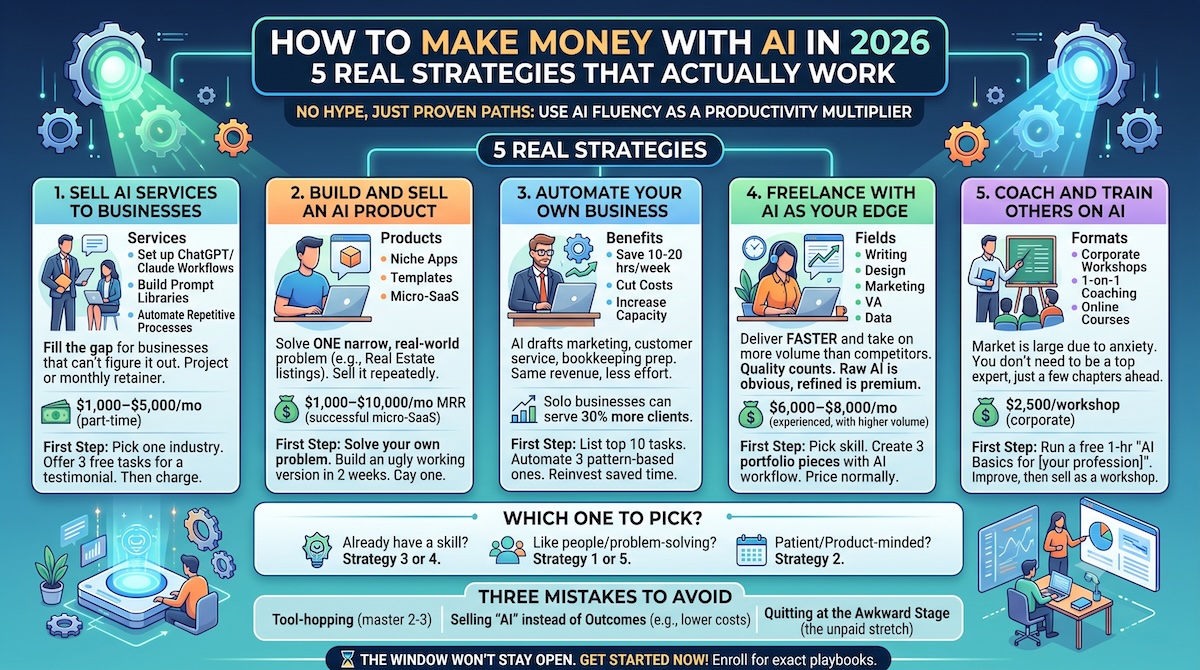
So let’s be straight with each other first: AI is not a money machine. Nobody is getting rich by typing prompts into ChatGPT while they sleep, whatever the ads promise. What AI is — and this part is genuinely exciting — is the biggest productivity multiplier available to an individual since the internet itself. It lets one person do what used to take a team. It lets a beginner produce work that used to require years of experience. And it’s created entirely new categories of paid work, because most businesses haven’t caught up yet.
You’re about to be ahead of them.
Below are five ways people are turning that gap into income right now. Each one covers how it works, what you need, what you can realistically earn, and your first concrete step. Read all five. Then pick one. Not three. One.
1. Sell AI Services to Businesses
This is the most direct route from “I know how to use AI” to “someone paid me money.”
Small and mid-sized business owners know AI matters. Almost none of them have time to figure it out. That gap is your opening. Typical services include:
- Setting up ChatGPT or Claude workflows for a company’s specific tasks
- Building prompt libraries for sales or support teams
- Automating repetitive processes like reporting or scheduling
- Cleaning up how a business handles content, email, or data
You can charge per project ($500–$5,000 for small business work) or as a monthly retainer ($1,000–$3,000 to be their ongoing “AI person”).
What it takes: Solid fluency with two or three major AI tools, the ability to translate a business owner’s problem into a workflow, and basic professionalism — clear proposals, reliable delivery. No coding required.
Realistic numbers: $1,000–$5,000 a month part-time with two or three clients. Full-time solo consultants commonly reach $8,000–$15,000 a month. Startup cost is close to zero — just tool subscriptions ($40–$100/month) and your time.
Your first step: Pick one industry you already understand — your current job counts. Find three tasks in it that AI handles well. Offer to set them up for one business free or cheap in exchange for a testimonial, then charge properly for the next one.
2. Build and Sell an AI Product
Instead of selling your time, you build something once and sell it repeatedly: a niche app powered by an AI model’s API, a specialized assistant, a template pack, or a micro-SaaS tool that solves one narrow problem.
The magic word is narrow. “AI writing app” is a graveyard. “AI that writes property listing descriptions for real estate agents” is a business.
What it takes: This is the most technically demanding option on this list — though tools like Claude Code, Cursor, and Replit have lowered the bar dramatically, since AI can now write much of the code itself. A no-code platform like Bubble or Glide works too. What matters more than code is product instinct: finding a real problem and reaching the people who have it. Marketing kills more products than bad code does.
Realistic numbers: Wide open on both ends. Most first products earn nothing or a few hundred dollars a month — treat that one as tuition. Successful micro-SaaS tools commonly reach $1,000–$10,000 in monthly recurring revenue. The outliers are famous: Pieter Levels built PhotoAI to over $100,000 a month largely solo. Startup costs run $50–$300/month in API and hosting fees.
Your first step: Solve a problem you personally have or see weekly at work. Build the ugliest working version in two weeks. Charge for it from day one — even $9 a month. Ten paying strangers means you have something.
3. Automate Your Own Business
Already run a business — freelancing, e-commerce, a service company, anything? The least glamorous, most reliable AI money is made by keeping your prices the same while cutting your costs and hours.
Let AI draft your customer service replies, marketing content, bookkeeping prep, proposals, and research. Same revenue, fewer expenses, more capacity to take on new clients. That margin is profit you didn’t have before.
What it takes: An existing business and the discipline to systematize. Write down what you do repeatedly, hand the repeatable parts to AI, and keep the judgment calls for yourself.
Realistic numbers: Owners who implement seriously report saving 10–20 hours a week and cutting costs by hundreds to thousands monthly. If AI lets a $100,000-a-year solo business serve 30% more clients with the same hours, that’s $30,000 in new income at almost no new cost. Startup cost: $50–$200/month in subscriptions.
Your first step: List the ten tasks you do most often. Mark the three that follow a pattern. Spend one focused week building an AI-assisted workflow for each, then reinvest the hours you save into revenue-producing work.
4. Freelance With AI as Your Edge
You freelance in an established category — writing, design, marketing, virtual assistance, data work — but use AI to deliver faster and take on more volume than competitors who aren’t using it. You’re not selling “AI services.” You’re selling the same deliverables clients already understand, produced faster, at a quality your editing and judgment protect.
What it takes: A marketable base skill (even a modest one — AI raises your floor dramatically), fluency with AI tools in your category, and strong quality control. Raw AI output is obvious and gets you fired. AI output refined by someone who knows the craft is indistinguishable from premium work.
Realistic numbers: Freelancers using AI well report handling two to three times their previous client load. Billed $3,000 a month before? $6,000–$8,000 becomes achievable at the same hours. New freelancers can reach $1,000–$3,000/month within six months by targeting AI-friendly categories on platforms like Upwork.
Your first step: Pick the freelance category closest to skills you already have. Build three portfolio pieces using an AI-assisted workflow and time yourself so you know your real capacity. Price normally — never discount for using AI. Speed and quality win you reviews.
5. Coach and Train Others on AI
Businesses and individuals will pay to be taught what you’re learning right now. Formats include live workshops for companies ($1,000–$5,000 per session for small-business training), one-on-one coaching, online courses, and corporate lunch-and-learns. The market is enormous because the anxiety is enormous — everyone knows they should “figure out AI,” and most would rather pay someone to walk them through it.
What it takes: You don’t need to be a world expert. You need to be two chapters ahead of your audience and good at explaining. Teaching skill matters more than technical depth. A simple, repeatable framework for how you teach the material makes you referable.
Realistic numbers: Corporate trainers running two workshops a month at $2,500 each earn $60,000 a year from what’s nearly a side gig. Niche courses at $99–$499 with real marketing reach $2,000–$20,000 monthly. Startup cost: under $100 for basic gear and a course platform.
Your first step: Run a free one-hour “AI basics for [your profession]” session for a local business group or your own industry contacts. Record it, collect feedback, then package the improved version as a paid workshop and pitch five organizations directly.
Which One Should You Pick?
Five paths is four too many to start with, so use this filter:
- Already have a skill or business? Start with Strategy 3 or 4 — augmenting what already works is the fastest money.
- Like people and problem-solving? Strategies 1 and 5 fit — they’re sales-and-relationship businesses wearing an AI costume.
- Patient and product-minded? Strategy 2 builds an asset that eventually earns while you sleep, at the cost of a slower start.
Three Mistakes to Avoid
Tool-hopping. New AI tools launch daily, and beginners burn months sampling all of them instead of earning with any of them. Master two or three and ignore the rest until a client’s problem demands more.
Selling “AI” instead of outcomes. No business owner wants a chatbot — they want fewer missed calls, faster replies, lower costs. Lead every pitch with the result. Mention the technology second, if at all.
Quitting at the awkward stage. Every strategy here has an unpaid or underpaid stretch at the beginning — the free workshop, the $9-a-month product, the discounted first client. That stretch isn’t a sign it’s not working. It’s the price of admission, and it’s shorter than you think.
The Window Won’t Stay Open
Right now, AI fluency is rare enough to be valuable and common enough to be trusted. That gap — between what you know and what most businesses know — is where all of this income lives. It won’t stay open forever.
If you’re ready to stop reading about AI and start earning from it, this is exactly what we walk through step by step inside the full course — the tools, the workflows, and the exact playbooks behind every strategy above. Enroll now and turn today’s read into next month’s first paying client.
Good work