AI for Small Business: What It Actually Is (No Jargon, No Hype)
A plain-English guide to what AI is, where it came from, and why it’s worth your time — even if you’ve never touched a line of code.
Here’s a confession: most people using AI every day couldn’t tell you how it actually works. And that’s fine — you don’t need to be a mechanic to drive a car.
But if you’re a business owner, a little bit of “what’s under the hood” goes a long way. It helps you spot real opportunities, avoid expensive mistakes, and stop feeling like AI is a magic trick happening to everyone else. So let’s fix that, in plain English, starting now.
So What Is AI, Really?
Strip away the sci-fi movie posters and the buzzwords, and AI is this: technology that lets computers do things that normally take human-like skills. Understanding language. Spotting patterns. Making predictions. Recommending what to do next.
Think of it as a very fast assistant who has studied an enormous number of examples. It doesn’t “think” the way you do. It uses patterns in data to come up with a useful answer.
Take spam filters. Old-school filters worked off a list of suspicious words someone typed in by hand. Modern AI studies millions of real spam and real legitimate emails, picks up on subtle combinations of clues, and predicts whether your new message is junk. No one wrote a rule for every trick spammers use — the system learned the patterns itself.
Traditional Software vs. AI: The Vending Machine Test
Traditional software is a vending machine. Insert money, press B4, get the item in B4. Fixed steps, predictable outcome, every time.
AI behaves more like an experienced employee. Ask it to sort customer emails by urgency, even though every message is worded differently, and it makes a judgment call based on patterns it’s learned. That flexibility is powerful — but it also means the answer won’t be perfect 100% of the time.
You’re Already Using AI
You’ve probably used AI today without noticing:
- Your GPS predicting traffic and rerouting you
- Netflix recommending your next show
- Your bank flagging a weird charge
- Your phone cleaning up a blurry photo
Generative AI takes this further. Instead of just sorting or recommending things that already exist, it creates new stuff — an email, an ad, a lesson plan, a first draft of a proposal.
What AI Is Not
AI isn’t magic. It isn’t a human mind. And it definitely isn’t an automatic source of truth. It can misread a vague request, repeat biases baked into its training data, or state something false with total confidence.
The safest mindset: treat AI like a capable junior assistant. Give it context, check its work, correct its mistakes — and never let it make final calls on anything involving money, safety, hiring, health, legal matters, or private customer data.
A (Very) Brief History of AI
The idea of a “thinking machine” has been around for centuries, but things got real once computers showed up.
In 1950, Alan Turing asked a simple, sharp question: could a machine talk convincingly enough that you couldn’t tell it apart from a person? That question — the Turing Test — nudged AI from science fiction into science.
The term “artificial intelligence” itself was coined in 1956 at a workshop at Dartmouth College. Early researchers were optimistic their programs could soon reason like people. They could play simple games and follow logical rules — but computers were slow, data was scarce, and reality turned out to be a lot harder than expected.
Then Machines Started Learning From Examples
As computers got faster and data got more abundant, researchers shifted strategies. Instead of writing every rule by hand, they started showing systems examples and let the systems find the patterns themselves.
It’s the difference between handing a kid a written definition of “dog” versus just showing them a thousand labeled pictures of dogs and not-dogs. By the 2000s and 2010s, this approach — machine learning — was quietly running search engines, fraud detection, and speech recognition everywhere.
Then Came the Breakthrough
In 2017, a new model design called the transformer changed everything. It got remarkably good at connecting the dots between words across long stretches of text. Combine that with massive datasets and serious computing power, and you get large language models — systems that can write, summarize, translate, and follow instructions.
When chat-based AI tools went public, AI stopped being a big-tech-only toy. Suddenly a solo business owner could brainstorm a campaign, rewrite a customer email, or outline a training course in minutes.
How Language Models Actually Work (No PhD Required)
Here’s the simplest version: a language model learns patterns in text, then predicts what comes next.
Picture reading millions of books, webpages, and conversations, then playing an extremely advanced game of fill-in-the-blank. If a sentence starts, “The customer asked for a refund because…” — there are countless possible endings. The model calculates which words are statistically most likely to come next, based on everything it’s learned.
Tokens: The Building Blocks
Models don’t read whole sentences at once — they break text into small chunks called tokens (a short word, part of a longer word, a punctuation mark). It predicts one token, then the next, then the next — so fast it reads like a finished paragraph.
Think of the predictive text on your phone, but dramatically more powerful. Your phone guesses one word. A language model can carry that pattern all the way through an explanation, a sales letter, or a full conversation.
Why Your Prompt Matters So Much
A prompt is simply the instruction you give the AI. A vague prompt — “write an ad” — forces it to guess. A specific one gives it a real target:
“Write a friendly 100-word Facebook post for a family-owned Idaho landscaping company promoting spring cleanup appointments. Emphasize reliability and end with a call to request a free estimate.”
Same idea as briefing a new employee: clearer assignment, better output. And you can keep refining — ask for a draft, point out what’s missing, request a revision. That back-and-forth is called iteration, and it’s how good AI use actually happens.
Why It Sometimes Just Makes Things Up
A language model is built to generate a plausible answer, not a guaranteed-true one. When it doesn’t have solid information, it can produce something that sounds confident but is flat-out wrong. This is called a hallucination.
The fix isn’t to avoid AI — it’s to verify anything important: names, prices, quotes, stats, legal claims. Human review isn’t a sign the tool failed. It’s part of using it like a professional.
Key AI Terms, Decoded
Quick reference so you can nod along in any meeting:
- Machine learning — a computer learning patterns from examples instead of fixed rules (think: predicting next month’s best sellers)
- Deep learning / neural networks — a more advanced form of machine learning, especially good at images, speech, and language
- Generative AI — AI that creates new content: text, images, audio, code
- Large language model (LLM) — a generative AI model trained on massive amounts of text, capable of answering, summarizing, and drafting
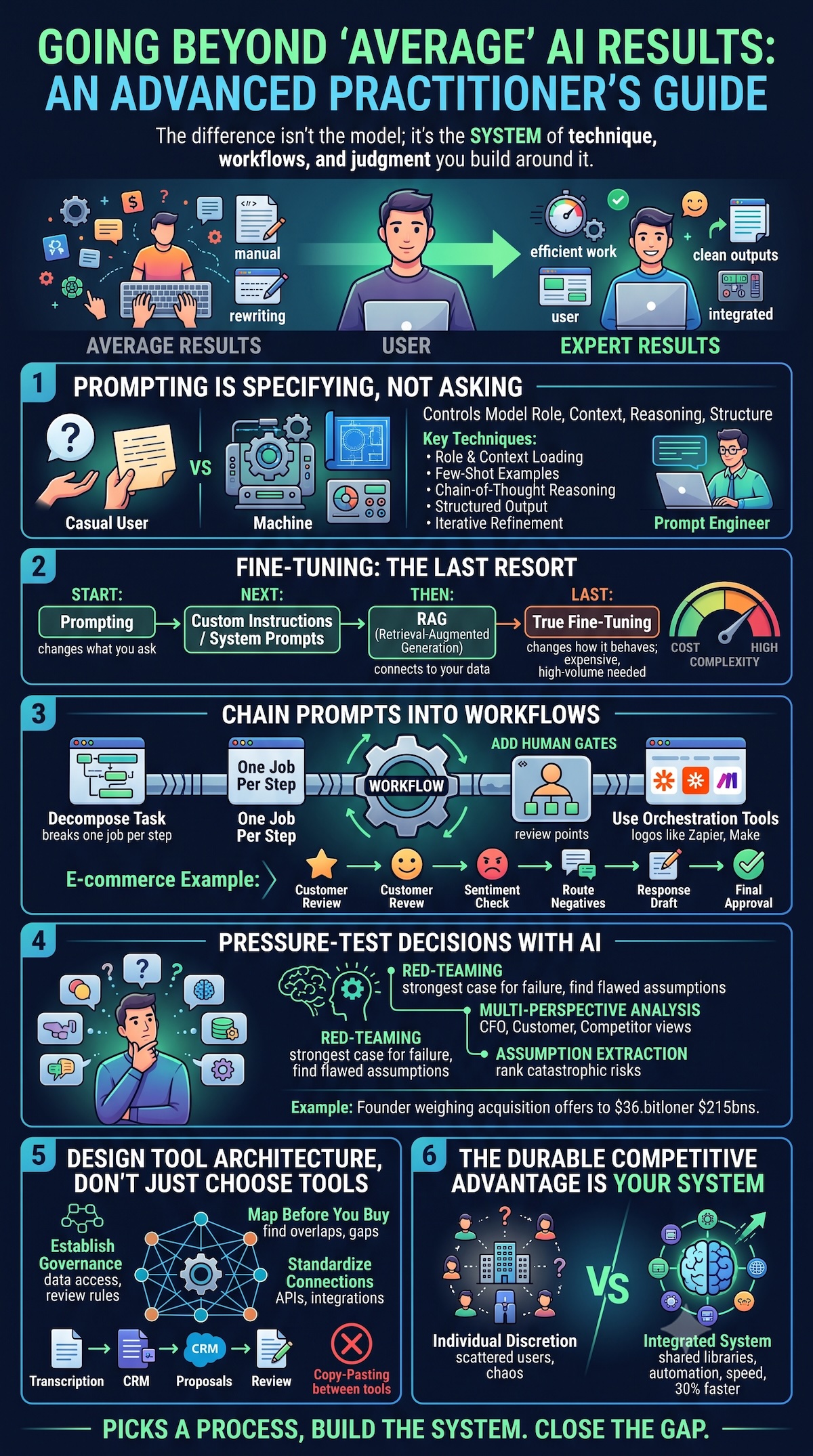
- Prompt engineering — designing clearer instructions to get better results
- Training data — the examples used to teach a model; quality and bias here shape everything downstream
- Automation — doing a repeated task with little manual effort (not always AI — a basic auto-email isn’t AI until it’s personalized or generated dynamically)
- Chatbot, copilot, agent — a chatbot just converses; a copilot assists while you stay in control; an agent pursues a goal across multiple steps, often with more independence (and more oversight needed)
- Hallucination — a confident-sounding but incorrect AI answer
- Bias — unfair or unbalanced results, often inherited from training data — a serious risk in hiring, lending, or customer targeting
- Human in the loop — a person reviewing, approving, or correcting AI output — arguably the most important concept on this list
Why Any of This Matters for Your Business
It cuts the cost of routine work. Drafting, sorting, summarizing, data entry — AI can chip away at all of it. Save five hours a week, and that’s five hours back toward sales or customer relationships. That’s not just convenience. That’s revenue.
It can sharpen your marketing and sales. One recorded workshop can become a summary, a newsletter, five social posts, an FAQ page, and a follow-up offer — all without watering down your expertise. AI just helps you package and distribute it further.
It can unlock entirely new offers. Personalized study guides. A product-finder assistant. Custom itineraries. You don’t need to sell AI — you can quietly use it to deliver your existing service faster, better, or to more people.
It protects you from expensive mistakes. Before buying any AI tool, ask: What problem does this actually solve? What information does it need? Who reviews the output? What happens if it’s wrong? Start small, measure the results, then scale what works.
The businesses that win with AI won’t be the ones with the most tools. They’ll be the ones who pair real technology with real expertise, solid processes, and good judgment.
Ready to Go Deeper?
This is just the surface. If you want the full walkthrough — prompt engineering, building AI workflows, automating and scaling, and using AI responsibly without cutting corners — that’s exactly what the complete course covers.
Sign up for the full course and turn “I’ve heard of AI” into “I actually know how to use this in my business.”